Introduction
Customer Relationship Management (CRM) technology has become one of the most important tools in modern business. Companies of all sizes rely on CRM systems to manage customer interactions, improve sales performance, enhance customer service, and build long-term relationships. However, the CRM platforms we know today are the result of decades of technological advancement and changing business needs.
The evolution of CRM technology reflects how organizations have adapted to new communication channels, growing customer expectations, and rapid digital transformation. From simple contact management databases to sophisticated artificial intelligence-powered platforms, CRM has continuously evolved to help businesses better understand and serve their customers.
Understanding the history and development of CRM technology provides valuable insight into its current capabilities and future potential.
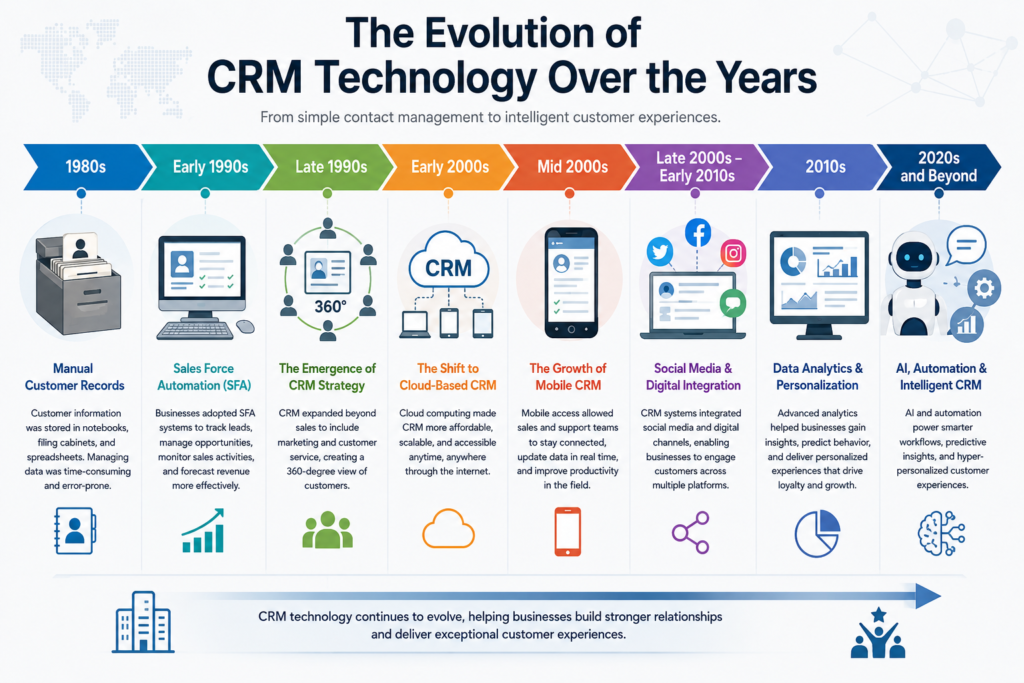
The Early Days of Customer Management
Before CRM software existed, businesses managed customer information manually. Sales representatives kept customer details in notebooks, filing cabinets, spreadsheets, and paper records. While this approach worked for small businesses, it became increasingly difficult as organizations grew and customer databases expanded.
During the 1980s, companies began using digital contact management systems to organize customer information more efficiently. These early tools primarily focused on storing names, phone numbers, addresses, and notes about customer interactions. Although basic by today’s standards, they represented a major step forward in customer data management.
The main challenge of these systems was their limited functionality. They acted as digital address books rather than comprehensive customer relationship tools. Nevertheless, they laid the foundation for the CRM solutions that would emerge in the following decades.
The Rise of Sales Force Automation
In the early 1990s, businesses started recognizing the need for more advanced customer management tools. This led to the development of Sales Force Automation (SFA) systems.
Sales Force Automation solutions helped organizations track sales activities, manage leads, monitor opportunities, and forecast revenue. Instead of simply storing customer information, these systems supported the entire sales process.
Sales teams could now record customer interactions, schedule follow-ups, and manage pipelines more effectively. Managers gained visibility into sales performance and could make better decisions based on real-time data.
The introduction of SFA technology marked an important transition from simple contact management to strategic customer relationship management. Companies began viewing customer data as a valuable business asset rather than just administrative information.
The Emergence of CRM as a Business Strategy
By the mid-to-late 1990s, CRM evolved beyond sales automation and became a broader business philosophy. Organizations realized that maintaining strong customer relationships required coordination across multiple departments, including sales, marketing, and customer support.
CRM systems expanded to include customer service management, marketing automation, and analytics capabilities. Businesses could now track the entire customer journey from initial contact through post-sale support.
This period also saw the rise of major CRM vendors that introduced integrated platforms designed to centralize customer information. Instead of maintaining separate databases across departments, companies could access a unified customer profile.
The concept of a 360-degree customer view became increasingly important. Organizations sought to understand customer behavior, preferences, purchase history, and communication patterns in order to deliver better experiences and increase loyalty.
The Shift to Cloud-Based CRM
One of the most significant milestones in CRM history occurred in the early 2000s with the introduction of cloud computing. Traditional CRM systems required expensive hardware, complex installations, and ongoing maintenance. These barriers made CRM adoption difficult for many small and medium-sized businesses.
Cloud-based CRM transformed the industry by delivering software through the internet. Businesses could access CRM platforms from any location without investing heavily in infrastructure.
The Software-as-a-Service (SaaS) model made CRM more affordable, scalable, and accessible. Companies could subscribe to CRM services on a monthly basis rather than purchasing costly software licenses.
Cloud CRM also improved collaboration. Employees working in different locations could access the same customer information in real time. This capability became increasingly valuable as businesses expanded globally and remote work gained popularity.
The success of cloud CRM fundamentally changed customer relationship management and accelerated adoption across industries.
The Growth of Mobile CRM
As smartphones and tablets became widespread, CRM technology adapted to support mobile workforces. Sales professionals, customer service representatives, and managers needed access to customer information while traveling or meeting clients.
Mobile CRM applications enabled users to view customer records, update opportunities, schedule appointments, and communicate with team members from virtually anywhere. This flexibility improved productivity and reduced delays in customer communication.
The introduction of mobile CRM also enhanced data accuracy. Employees could update information immediately after customer interactions rather than waiting until they returned to the office.
For field sales teams, mobile CRM became an essential tool that streamlined workflows and improved customer engagement. The ability to access real-time information on demand significantly increased the value of CRM systems.
The Integration of Social Media and Digital Channels
The rise of social media platforms in the late 2000s and early 2010s created new opportunities and challenges for customer relationship management.
Customers increasingly interacted with brands through social networks, online reviews, messaging platforms, and digital communities. CRM systems evolved to capture and manage these interactions alongside traditional communication channels.
Social CRM emerged as a new category that combined customer relationship management with social media monitoring and engagement. Businesses could track customer conversations, respond to inquiries, and analyze sentiment across multiple platforms.
This evolution enabled organizations to gain deeper insights into customer opinions and preferences. Instead of relying solely on direct communications, companies could observe customer behavior across the broader digital ecosystem.
As a result, CRM became more customer-centric and responsive to changing consumer expectations.
The Era of Data Analytics and Personalization
The rapid growth of digital data transformed CRM systems into powerful analytics platforms. Businesses gained access to vast amounts of customer information from websites, mobile apps, social media, email campaigns, and transactional systems.
Modern CRM solutions began incorporating advanced reporting and analytics capabilities. Organizations could identify trends, measure performance, predict customer behavior, and optimize marketing strategies.
Personalization became a key focus. CRM platforms enabled businesses to deliver targeted content, customized recommendations, and personalized customer experiences based on individual preferences and behavior.
The ability to analyze customer data at scale helped companies improve engagement, increase retention, and drive revenue growth. Data-driven decision-making became a central component of successful CRM strategies.
Artificial Intelligence and Automation in Modern CRM
Today, artificial intelligence (AI) is reshaping CRM technology in unprecedented ways. AI-powered CRM systems can automate routine tasks, analyze large datasets, and provide intelligent recommendations.
Machine learning algorithms help businesses identify high-value prospects, predict customer churn, forecast sales outcomes, and recommend next-best actions. Chatbots and virtual assistants provide instant customer support while reducing operational costs.
AI also enhances personalization by analyzing customer behavior patterns and delivering highly relevant experiences. Automated workflows streamline repetitive processes, allowing employees to focus on more strategic activities.
Predictive analytics has become one of the most valuable features of modern CRM platforms. Businesses can anticipate customer needs and proactively address issues before they impact satisfaction.
As AI technology continues to advance, CRM systems are becoming smarter, more efficient, and increasingly capable of supporting complex business objectives.
The Future of CRM Technology
The future of CRM technology will likely be defined by deeper automation, enhanced artificial intelligence, and greater integration across business systems. Organizations will continue seeking ways to create seamless customer experiences across every touchpoint.
Emerging technologies such as generative AI, conversational interfaces, augmented reality, and advanced predictive analytics are expected to further transform CRM capabilities. These innovations will help businesses understand customers more accurately and respond more effectively to changing needs.
Privacy and data security will also play an increasingly important role. As customer data becomes more valuable, organizations must balance personalization with responsible data management and regulatory compliance.
Future CRM platforms will likely focus on delivering real-time insights, automated decision-making, and highly personalized customer experiences that strengthen loyalty and drive long-term growth.
Conclusion
The evolution of CRM technology over the years reflects the ongoing transformation of business and customer relationships. What began as simple contact management software has developed into a sophisticated ecosystem that combines cloud computing, mobile accessibility, social engagement, data analytics, and artificial intelligence.
Each stage of CRM development has brought new opportunities for businesses to better understand and serve their customers. As technology continues to advance, CRM will remain a critical tool for building meaningful customer relationships and achieving sustainable business success.
Organizations that embrace modern CRM innovations will be better positioned to meet customer expectations, improve operational efficiency, and compete effectively in an increasingly digital world.