Introduction
Customer Relationship Management (CRM) systems have become essential tools for businesses of all sizes. They help organizations manage customer interactions, store valuable data, improve sales processes, and deliver personalized customer experiences. As companies increasingly rely on CRM platforms to collect and analyze customer information, protecting that data has become more important than ever. CRM security is no longer just an IT concern; it is a critical business priority that directly impacts customer trust, regulatory compliance, and company reputation.
Modern CRM systems contain a wealth of sensitive information, including customer names, addresses, phone numbers, email addresses, purchase histories, payment details, and communication records. If this information falls into the wrong hands, the consequences can be severe. Data breaches can lead to financial losses, legal penalties, and long-term damage to customer relationships. For this reason, businesses must implement strong security measures to safeguard customer information and ensure the integrity of their CRM systems.
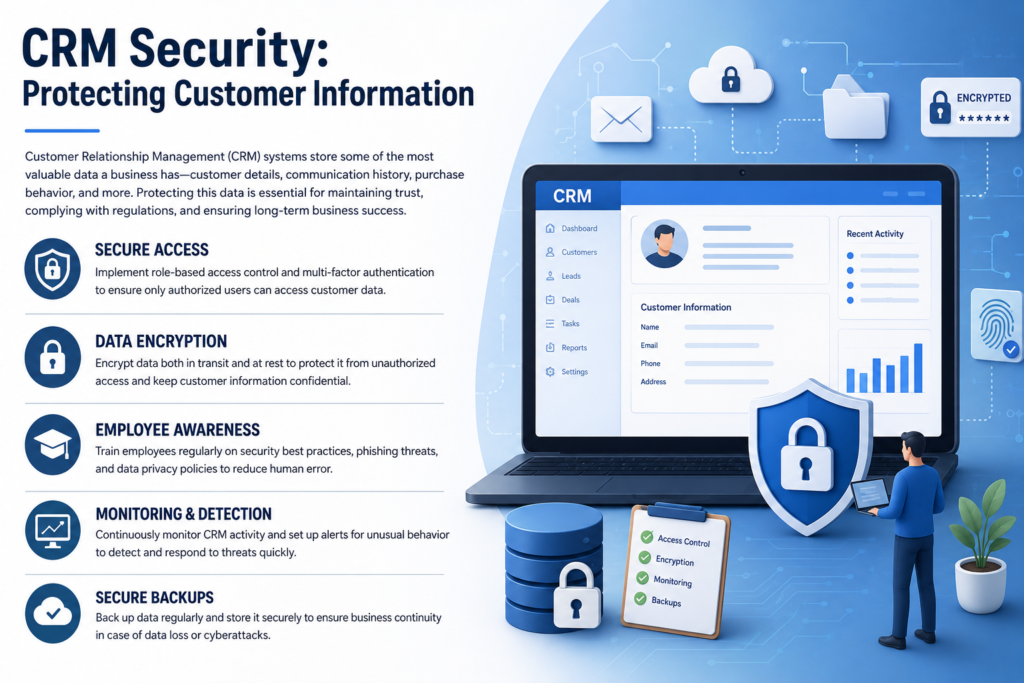
Why CRM Security Matters
Customer data is one of the most valuable assets a business possesses. Organizations use this information to understand customer preferences, personalize marketing campaigns, improve customer service, and drive revenue growth. However, cybercriminals also recognize the value of this data and frequently target businesses through phishing attacks, malware, ransomware, and unauthorized access attempts.
A security breach involving a CRM system can expose thousands or even millions of customer records. Such incidents often result in negative publicity and loss of customer confidence. Customers expect businesses to protect their personal information, and any failure to do so can lead them to seek alternatives from competitors.
Beyond customer trust, businesses must also comply with various data protection regulations. Laws such as the General Data Protection Regulation (GDPR), the California Consumer Privacy Act (CCPA), and other regional privacy regulations impose strict requirements on how customer information is collected, stored, and processed. Failure to comply with these regulations can result in substantial fines and legal consequences.
Common CRM Security Threats
CRM systems face a wide range of security threats. One of the most common threats is unauthorized access. This occurs when individuals gain access to customer information without proper permission. Unauthorized access can result from weak passwords, stolen credentials, or insufficient access controls.
Phishing attacks are another major concern. Cybercriminals often send deceptive emails designed to trick employees into revealing login credentials or downloading malicious software. Once attackers gain access to CRM accounts, they can steal sensitive data or compromise the entire system.
Insider threats also pose significant risks. Employees, contractors, or partners with legitimate access to CRM systems may intentionally or accidentally expose customer information. In many cases, data leaks occur due to human error rather than malicious intent.
Malware and ransomware attacks represent another growing challenge. These attacks can encrypt customer data, disrupt business operations, or provide attackers with unauthorized access to sensitive information. Organizations that fail to maintain strong cybersecurity defenses may find themselves vulnerable to these threats.
Cloud-based CRM systems can also face security risks if they are improperly configured. Misconfigured settings, unsecured APIs, and inadequate security policies can create opportunities for attackers to exploit vulnerabilities and gain access to valuable customer data.
Implementing Strong Access Controls
One of the most effective ways to improve CRM security is through strong access control measures. Not every employee needs access to all customer information. Organizations should follow the principle of least privilege, granting users only the access necessary to perform their job responsibilities.
Role-based access control allows businesses to assign permissions based on specific job functions. Sales representatives may require access to customer contact information, while finance teams may need access to billing data. Limiting access reduces the risk of unauthorized data exposure and minimizes potential damage if an account is compromised.
Multi-factor authentication adds an additional layer of security by requiring users to verify their identity using multiple authentication methods. Even if a password is stolen, attackers will have difficulty accessing the system without the second verification factor.
Regularly reviewing user permissions is equally important. As employees change roles or leave the organization, access rights should be updated promptly to prevent unauthorized access to sensitive customer information.
Data Encryption and Secure Storage
Encryption plays a crucial role in protecting customer information within CRM systems. Encryption converts data into a format that can only be read by authorized parties with the appropriate decryption keys. This ensures that even if data is intercepted or stolen, it remains unreadable to unauthorized users.
Organizations should implement encryption both in transit and at rest. Data in transit refers to information being transmitted between users and CRM servers, while data at rest refers to information stored within databases and storage systems. Securing both types of data helps reduce the risk of exposure during communication and storage.
Secure storage practices are also essential. Businesses should use reputable CRM providers that employ robust security measures, including secure data centers, backup systems, and advanced monitoring capabilities. Regular backups ensure that customer information can be recovered in the event of data loss, hardware failure, or ransomware attacks.
Employee Training and Security Awareness
Technology alone cannot guarantee CRM security. Employees play a critical role in protecting customer information and must be educated about potential security risks. Human error remains one of the leading causes of data breaches, making security awareness training an essential component of any CRM security strategy.
Employees should learn how to recognize phishing emails, avoid suspicious links, create strong passwords, and follow established security procedures. Regular training sessions help reinforce best practices and keep staff informed about emerging threats.
Organizations should also establish clear policies regarding data handling and customer privacy. Employees must understand their responsibilities when accessing, sharing, and storing customer information. A strong security culture encourages accountability and reduces the likelihood of accidental data exposure.
Monitoring and Incident Response
Continuous monitoring is essential for identifying potential security threats before they cause significant damage. Modern CRM platforms often include monitoring tools that track user activity, detect unusual behavior, and generate alerts when suspicious actions occur.
Security teams should regularly review system logs and audit trails to identify unauthorized access attempts or unusual data activity. Early detection allows organizations to respond quickly and prevent further compromise.
An effective incident response plan is equally important. Despite the best security measures, no system is completely immune to attacks. Organizations must have a clear plan for responding to security incidents, including procedures for containment, investigation, communication, and recovery.
A well-prepared response plan minimizes disruption and helps organizations restore normal operations more quickly. It also demonstrates a commitment to protecting customer information and maintaining transparency during security incidents.
Choosing a Secure CRM Platform
Selecting the right CRM platform is a critical security decision. Businesses should evaluate potential CRM providers based on their security capabilities, compliance certifications, and reputation for protecting customer data.
Key features to consider include data encryption, multi-factor authentication, access controls, audit logging, automatic backups, and compliance with relevant industry standards. Organizations should also review the provider’s security policies and understand how customer data is stored, processed, and protected.
Regular security updates are another important factor. CRM vendors should actively monitor for vulnerabilities and release updates to address emerging threats. Choosing a provider with a strong security track record can significantly reduce the risk of data breaches.
Conclusion
CRM security is a fundamental requirement for any organization that collects and manages customer information. As cyber threats continue to evolve, businesses must take proactive steps to protect sensitive data from unauthorized access, theft, and misuse. Strong access controls, encryption, employee training, continuous monitoring, and secure CRM platform selection all contribute to a comprehensive security strategy.
Protecting customer information is not only about avoiding financial losses or regulatory penalties. It is about building trust and maintaining long-term relationships with customers who expect their personal data to be handled responsibly. By prioritizing CRM security, businesses can create a safer environment for customer interactions, strengthen their reputation, and support sustainable growth in an increasingly digital world.