Introduction
Customer Relationship Management (CRM) systems have become an essential part of modern business operations. Organizations of all sizes rely on CRM platforms to manage customer interactions, streamline sales processes, improve customer service, and gain valuable insights from data. When implemented correctly, a CRM system can increase productivity, strengthen customer relationships, and drive sustainable business growth.
However, many CRM projects fail to deliver the expected results. Businesses often invest significant time and resources into CRM software only to encounter low user adoption, poor data quality, workflow disruptions, and disappointing returns on investment. In most cases, these problems are not caused by the technology itself but by mistakes made during the implementation process.
Understanding the most common CRM implementation mistakes can help organizations avoid costly setbacks and maximize the value of their investment. This article explores these mistakes and provides practical strategies to ensure a successful CRM implementation.
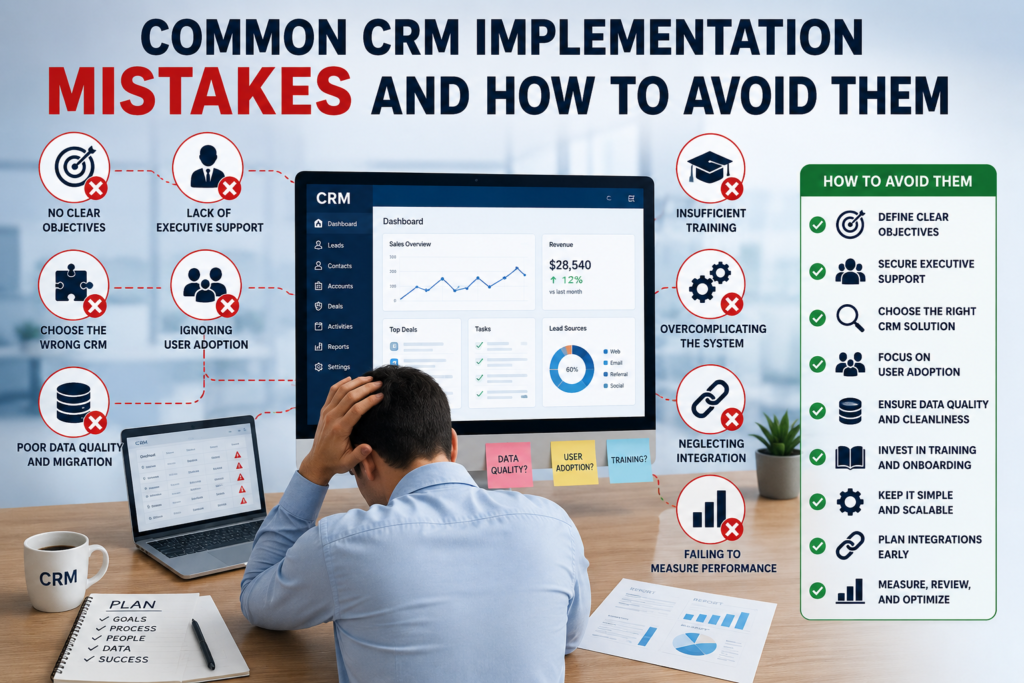
Failing to Define Clear Objectives
One of the most common mistakes organizations make is implementing a CRM system without clearly defined goals. Many businesses purchase CRM software because competitors use it or because they believe it will automatically solve operational challenges. Without specific objectives, however, the implementation process can quickly lose direction.
A successful CRM project begins with identifying what the organization wants to achieve. These goals may include improving sales conversion rates, enhancing customer service, increasing customer retention, or creating a centralized customer database. Clear objectives provide a roadmap for configuration, training, and performance measurement.
To avoid this mistake, organizations should establish measurable goals before implementation begins. Stakeholders from different departments should collaborate to define expected outcomes and key performance indicators (KPIs) that will be used to evaluate success.
Lack of Executive Support
CRM implementation is not merely an IT project. It often requires significant changes to business processes, employee workflows, and organizational culture. Without strong support from leadership, employees may not view the initiative as a priority.
When executives fail to actively participate in the project, resistance to change can increase. Employees may continue using old methods, leading to inconsistent data and reduced system effectiveness. Additionally, projects without executive sponsorship often struggle to secure the necessary resources and budget.
Organizations can avoid this issue by ensuring leadership involvement from the beginning. Executives should communicate the importance of the CRM initiative, provide ongoing support, and demonstrate commitment by using CRM-generated insights in decision-making processes.
Choosing the Wrong CRM Solution
Not all CRM platforms are designed for the same business needs. Some systems focus primarily on sales automation, while others emphasize customer service, marketing automation, or industry-specific functionality. Selecting a CRM based solely on price or popularity can lead to significant challenges later.
Businesses often underestimate the importance of evaluating their unique requirements. A CRM that works well for a large enterprise may be overly complex for a small business, while a simple solution may lack the capabilities required by a growing organization.
To avoid choosing the wrong CRM, companies should conduct a thorough needs assessment. This process should include evaluating current workflows, identifying essential features, considering future growth requirements, and involving end users in the selection process. A well-matched CRM platform is more likely to deliver long-term value.
Ignoring User Adoption
Even the most advanced CRM system will fail if employees refuse to use it. User adoption remains one of the biggest challenges in CRM implementation. Employees often resist new systems because they perceive them as complicated, time-consuming, or unnecessary.
Poor adoption typically occurs when users are not involved in the implementation process or when they do not understand how the CRM will benefit their daily work. If employees see the system as an additional burden rather than a helpful tool, usage rates will remain low.
Organizations can improve user adoption by involving employees early in the project, gathering feedback during system design, and clearly communicating the benefits of the CRM. Providing ongoing support and recognizing successful usage can also encourage greater engagement.
Insufficient Training and Onboarding
Many organizations assume that employees will naturally learn how to use a new CRM system after installation. This assumption often leads to frustration, errors, and underutilization of key features.
CRM platforms typically contain numerous tools, dashboards, automation capabilities, and reporting functions. Without proper training, users may only utilize a small fraction of the available functionality, limiting the system’s overall effectiveness.
A comprehensive training program is essential for successful implementation. Training should be tailored to different user roles and include hands-on exercises that reflect real business scenarios. In addition, organizations should offer ongoing learning opportunities as new features are introduced or business processes evolve.
Poor Data Quality and Migration Practices
Data serves as the foundation of every CRM system. Unfortunately, many organizations transfer outdated, duplicate, incomplete, or inaccurate information into their new CRM. Poor data quality can undermine the entire implementation effort.
When users encounter unreliable customer records, they quickly lose confidence in the system. Sales forecasts become inaccurate, marketing campaigns target the wrong audience, and customer service teams struggle to deliver personalized experiences.
To prevent these issues, organizations should conduct a thorough data audit before migration. Duplicate records should be removed, outdated information should be updated, and data standards should be established. Testing the migration process before full deployment can also help identify potential problems early.
Overcomplicating the System
Another frequent mistake is attempting to customize the CRM excessively during implementation. While customization can improve alignment with business processes, too many modifications can create complexity, increase costs, and make future upgrades more difficult.
Organizations sometimes try to replicate every aspect of their existing workflows within the new CRM rather than taking advantage of proven best practices built into the software. This approach often results in a cluttered system that users find difficult to navigate.
The best approach is to keep the initial implementation as simple as possible. Businesses should focus on essential features and processes first, then gradually introduce additional functionality as users become more comfortable with the system.
Neglecting Integration Requirements
A CRM system rarely operates in isolation. It often needs to connect with marketing platforms, accounting software, customer support systems, e-commerce platforms, and other business applications.
Failure to plan for integrations can lead to data silos, duplicate work, and inconsistent customer information across departments. Employees may be forced to manually transfer data between systems, reducing efficiency and increasing the likelihood of errors.
To avoid this mistake, organizations should evaluate integration requirements during the planning stage. Understanding how information flows across the business helps ensure seamless connectivity and a unified customer experience.
Failing to Measure Performance
Many businesses consider CRM implementation complete once the system goes live. However, successful implementation requires continuous monitoring and optimization. Without performance measurement, organizations cannot determine whether the CRM is delivering the desired results.
Metrics such as user adoption rates, sales productivity, customer retention, response times, and revenue growth can provide valuable insights into system effectiveness. Monitoring these indicators helps identify areas for improvement and supports data-driven decision-making.
Regular reviews should be conducted to assess performance against predefined goals. Feedback from users can also reveal opportunities to improve workflows, training programs, and system configurations.
Conclusion
CRM implementation is a significant investment that can transform how businesses manage customer relationships and drive growth. However, success depends on more than simply purchasing the right software. Organizations must carefully plan the implementation process, establish clear objectives, secure executive support, ensure user adoption, maintain data quality, and continuously monitor performance.
By understanding and avoiding common CRM implementation mistakes, businesses can increase the likelihood of a successful deployment and achieve a stronger return on investment. A well-executed CRM strategy not only improves operational efficiency but also creates meaningful customer experiences that contribute to long-term business success.