Introduction
Customer Relationship Management, commonly known as CRM, has become an essential tool for businesses of all sizes. Companies rely on CRM systems to manage customer interactions, improve sales performance, enhance customer service, and streamline internal processes. As digital transformation continues to shape modern business operations, choosing the right CRM solution is more important than ever.
When selecting a CRM platform, businesses often face one major decision: should they use a cloud-based CRM or an on-premise CRM? Both options offer powerful features, but they differ significantly in terms of cost, flexibility, security, maintenance, and scalability. Understanding these differences can help organizations choose the system that best fits their operational needs and long-term goals.
This article explains the key differences between cloud-based CRM and on-premise CRM, including their advantages, disadvantages, and the situations where each solution works best.
What Is a Cloud-Based CRM?
A cloud-based CRM is a customer relationship management system hosted on external servers and accessed through the internet. Instead of installing software on local computers or company servers, users simply log in through a web browser or mobile application.
The CRM provider is responsible for hosting the software, maintaining the infrastructure, handling updates, and managing data backups. Popular cloud CRM platforms include Salesforce, HubSpot, Zoho CRM, and Microsoft Dynamics 365.
Cloud-based CRM solutions are usually offered through a subscription model, where businesses pay monthly or annual fees depending on the number of users and features required.
What Is an On-Premise CRM?
An on-premise CRM is installed and operated on a company’s own servers and infrastructure. Businesses purchase the software license and manage everything internally, including installation, updates, maintenance, security, and data storage.
With an on-premise CRM, organizations have complete control over the system and its customization. This option is often preferred by companies with strict data security policies or complex operational requirements.
Examples of on-premise CRM solutions include older deployments of Microsoft Dynamics, SAP CRM, and customized enterprise CRM platforms.
Key Differences Between Cloud-Based and On-Premise CRM
The primary difference between these two CRM models lies in where the software is hosted and who manages it. However, this distinction also affects many other aspects of business operations.
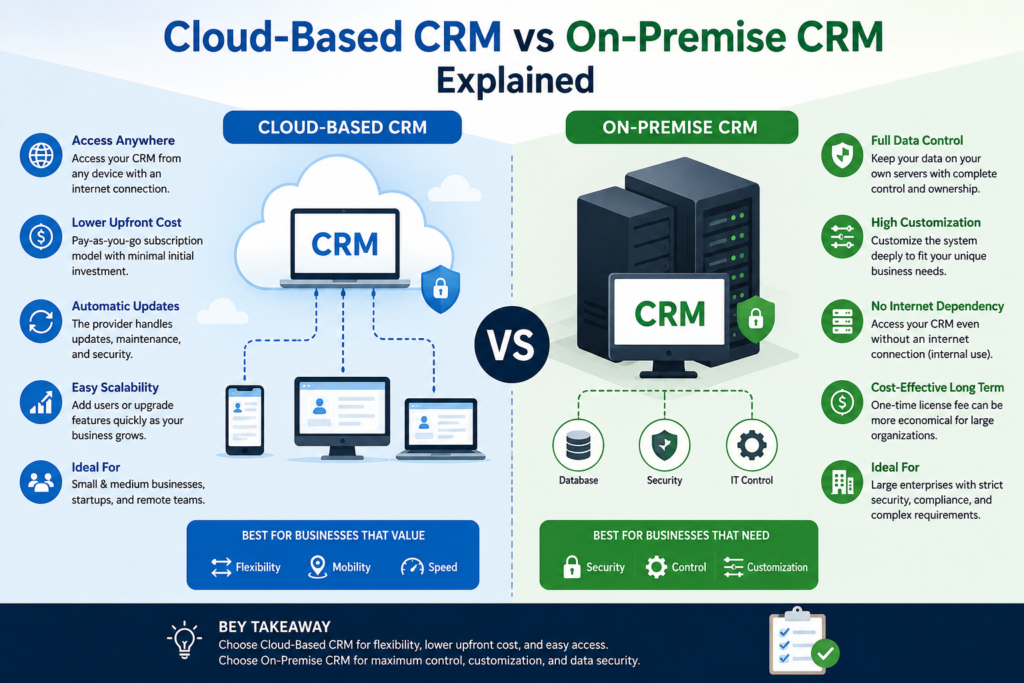
Cloud-based CRM systems are hosted by third-party providers and accessed online, while on-premise CRM systems are hosted locally within the company’s infrastructure. This directly impacts cost structure, deployment speed, maintenance responsibility, and scalability.
Cloud CRM platforms are generally easier to set up because businesses do not need to purchase hardware or install software manually. On-premise systems, on the other hand, often require dedicated IT teams and more complex implementation processes.
Another major difference is flexibility. Cloud CRM allows employees to access data remotely from anywhere with an internet connection, making it ideal for remote work and mobile sales teams. On-premise CRM systems may require VPN access or internal network connections, limiting accessibility.
Advantages of Cloud-Based CRM
One of the biggest advantages of cloud-based CRM is affordability. Since there is no need to invest heavily in servers or IT infrastructure, businesses can start using the system with lower upfront costs. Subscription pricing also allows companies to scale services according to their needs.
Cloud CRM systems are also highly flexible. Teams can access customer data from laptops, smartphones, or tablets regardless of location. This accessibility improves collaboration among remote employees and field sales representatives.
Automatic software updates are another major benefit. The CRM provider handles security patches, feature improvements, and system maintenance without disrupting business operations. This reduces the workload for internal IT departments.
Scalability is also easier with cloud-based CRM solutions. Businesses can quickly add users, increase storage capacity, or upgrade features as the company grows. This makes cloud CRM particularly attractive for startups and fast-growing businesses.
In addition, most cloud CRM providers offer strong integration capabilities with marketing tools, customer support platforms, e-commerce systems, and communication software.
Disadvantages of Cloud-Based CRM
Despite its advantages, cloud-based CRM also has limitations. One common concern is data security. Since customer information is stored on external servers, some businesses worry about privacy risks and unauthorized access.
Although leading CRM providers invest heavily in cybersecurity, companies operating in highly regulated industries may still prefer complete control over their data.
Another drawback is the dependency on internet connectivity. If internet access becomes unstable or unavailable, employees may struggle to use the CRM system effectively.
Long-term subscription costs can also become significant over time. While cloud CRM has lower initial costs, monthly fees for large teams may eventually exceed the cost of owning an on-premise solution.
Customization can sometimes be limited as well. Some cloud platforms restrict deep modifications to maintain system stability and compatibility across users.
Advantages of On-Premise CRM
On-premise CRM systems offer greater control over data and infrastructure. Businesses can manage their own security protocols, server configurations, and backup systems according to internal requirements.
This level of control is especially important for industries such as healthcare, banking, government, and legal services, where strict compliance regulations apply.
Customization is another major advantage. Companies can modify the CRM software extensively to match unique workflows, business models, and operational processes. This flexibility is valuable for enterprises with highly specialized needs.
On-premise CRM may also provide better long-term cost efficiency for large organizations. After the initial investment in software and infrastructure, ongoing operational costs may become lower compared to continuous subscription payments.
Performance can also be more stable in environments where internal servers are optimized specifically for company operations.
Disadvantages of On-Premise CRM
The biggest disadvantage of on-premise CRM is the high upfront cost. Businesses must purchase servers, software licenses, networking equipment, and security systems before implementation even begins.
Maintenance responsibilities also fall entirely on the organization. Internal IT teams must manage updates, troubleshoot technical issues, monitor security, and handle data backups regularly.
Implementation often takes longer as well. Installing and configuring on-premise CRM software can require weeks or even months depending on system complexity.
Scalability is another challenge. Expanding storage capacity or adding new users may require additional hardware investments and infrastructure upgrades.
Remote accessibility may also be less convenient compared to cloud-based solutions, especially for organizations without advanced remote access systems.
Which CRM Option Is Best for Your Business?
The best CRM solution depends on the size, goals, budget, and operational needs of the business.
Cloud-based CRM is usually the better choice for small and medium-sized businesses, startups, and companies with remote teams. It offers flexibility, fast deployment, lower upfront costs, and easier maintenance.
Businesses that prioritize mobility and rapid growth often benefit most from cloud CRM systems. Companies without large IT departments also prefer cloud solutions because technical management is handled by the provider.
On-premise CRM is more suitable for large enterprises or organizations with strict security and compliance requirements. Businesses that need deep customization and complete control over customer data may find on-premise systems more effective.
Companies with strong internal IT capabilities can also maximize the benefits of on-premise CRM infrastructure.
Conclusion
Both cloud-based CRM and on-premise CRM solutions offer valuable tools for managing customer relationships and improving business performance. However, each approach comes with unique strengths and challenges.
Cloud-based CRM provides flexibility, affordability, scalability, and ease of use, making it ideal for modern businesses seeking fast and efficient deployment. On-premise CRM offers greater control, advanced customization, and enhanced data ownership for organizations with specialized needs.
Before choosing a CRM system, businesses should carefully evaluate their budget, security requirements, growth plans, and technical capabilities. By understanding the differences between cloud-based and on-premise CRM, companies can make smarter decisions that support long-term success and stronger customer relationships.